Thesis · 2005
Glass Houses
Four miniature rooms from my thesis, Glass Houses: Invisible Connections.
Bo
Bo lived in the housing project directly behind the school. His box has the least light of the four. Inside are a small couch with newspapers, a television on a brass cart, and a hat and pocket watch on a side table.
Project statement
Glass Houses brings together people I knew at Ringling in four miniature rooms. Cable television became a way to explore the connections between their homes and the divisions of race and class.
Each shadow box recreates a real person’s room. I photographed each person to fit the scene and made the figures as Kodalith transparencies using an AB development process. The rooms combine purchased dollhouse furniture with paper, fabric, and found objects that I made or adapted to scale. The purchased miniatures were also part of the commentary on consumerism: versions of domestic life sold as objects.
The work also examined my own white privilege: being able to enter each home as a guest and move between very different social and economic circumstances.
Finishing the thesis
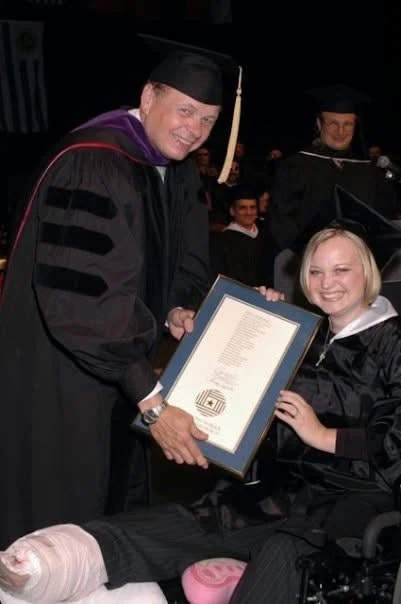
My colleagues at Bob Knight Photo took this photograph. I worked with their graduation crews across Florida during college. At my own graduation, I sat backstage with people I knew.
Graduation · May 2005
Two weeks before this photograph, another driver pulled out in front of me as I was returning from the dollhouse supply store. I braked but hit their car. I finished Glass Houses while recovering from surgery and using a wheelchair, moving the chair backwards to position the 4×5 camera. The BFA show opened on schedule.
This experience began my disability advocacy. Years later, at thirty-nine, my autism and ADHD diagnoses gave me another way to understand the work. The questions of race, class, and access in Glass Houses were connected to patterns I had noticed long before I could explain them.